DISTILL
Less scattered feedback. More useful questions.
Customer feedback arrives as fragments. Product teams need to inspect the themes without losing sight of the original input.
Independent product work; detailed authorship and collaborator attribution remain to be documented.
React / TypeScript / Vite / Tailwind
Inspected 2026-10-31
Original development date unverified
What you can
actually inspect.
- Text input and text-file upload
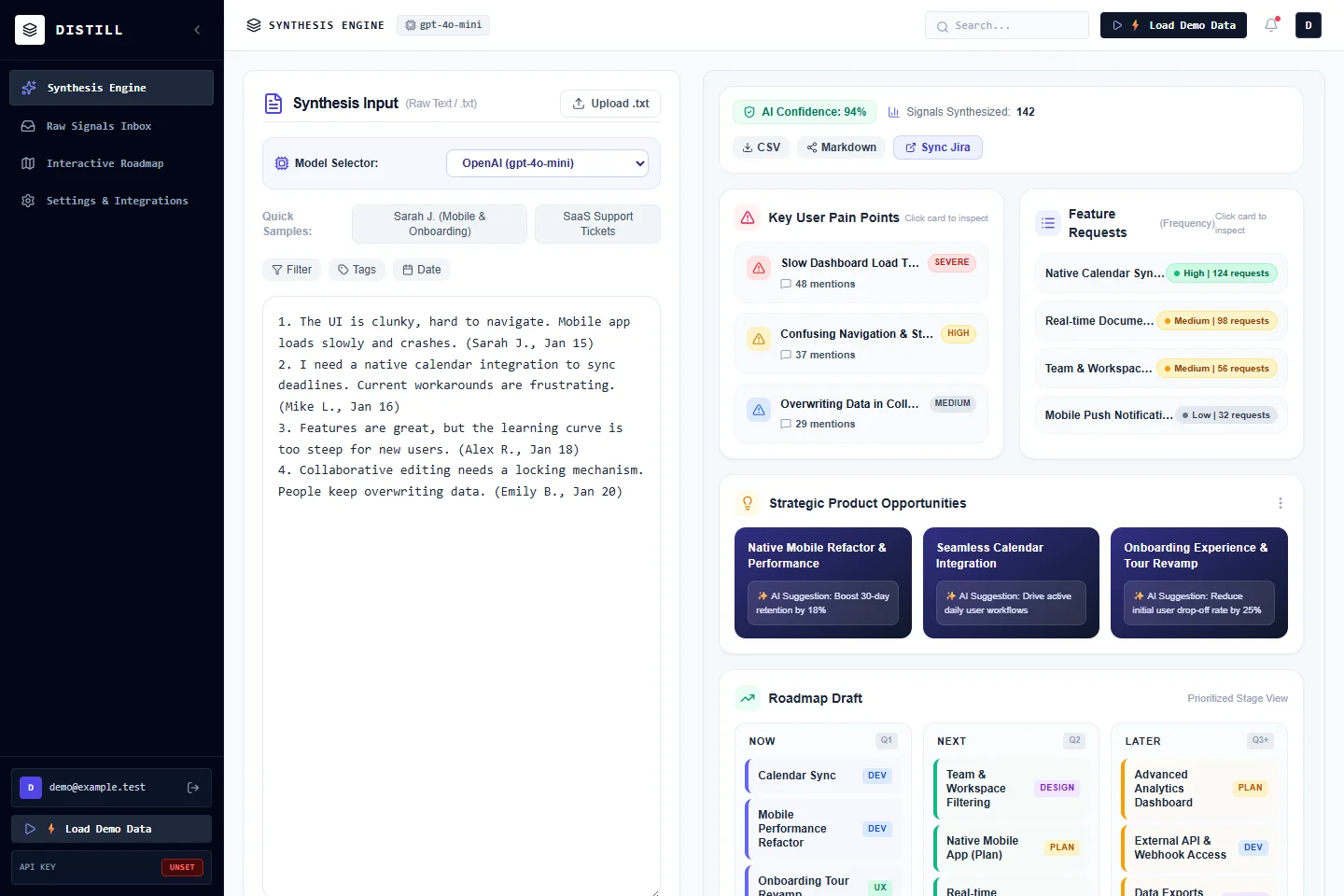
- Built-in demo data and analysis panels
- Inbox, roadmap and detail drawer views
- Model selection and provider request source
Demo output is a fixture. Provider code is present but real model output was not tested. Integration switches change local state; they do not establish connected services. Source includes invented fallback counts, so counts are not evidence of customer demand.
Bring your own
raw signals.
Find possible themes in feedback using DeepSeek. Review the output against the original words.
AI-generated analysis · verify against your sources
Open the working DISTILL sample workspace
Choose “Load Demo Data” to inspect the sample workspace. Synthetic authentication; live models and external services disabled.
Open the sample workspace in a separate tab ↗The decision
inside the interface.
Keep raw input beside the synthesis, and make the boundary between sample output and live analysis explicit.
Present-day source analysis, not historical research.
Under the hood / source evidence
- src/App.tsx
- src/context/DistillContext.tsx
- src/components/InputSection.tsx
- src/services/openai.ts
- Isolated demo-mode browser capture
Actual source UI in an isolated local render. Built-in sample data; fixture analysis, no live model call.
How can each synthesized claim be traced back to its actual source, without invented counts?
Usability and outcomes still need evidence.
Discuss the product